Lead time and redesign
Process review
Process review writes out one process the way it actually runs. Step by step, with the working time and the waiting time, with the handovers, the approvals and the coordination each step needs. Next to that goes what the step delivers to the customer, and what it costs the person doing it.
The picture is nearly always the same: every step on its own is quick, and the whole thing takes a long time. In a recruitment and selection process running over three months, fewer than six working days turned out to be actual work - 7.6 per cent of the lead time. The rest was waiting.
What we record for every step
- who carries it out, with how many people, and how long that takes
- how long the case then sits still before the next step begins
- who has to approve, and how far away that signature sits
- which document and which system are involved
- who has to be consulted before the step can move, and whether that waits on a fixed meeting
- whether it adds value for whoever receives the result
- whether it interrupts other work, duplicates work, or waits on someone else
- how often a case goes back from here to an earlier step
What we record for the process
- how often it runs a year, and what share follows the ordinary route
- who owns the line from beginning to end - the answer to that one often starts the conversation
- what it costs today, and what a redesign would yield
- what was actually measured six months after the change: the follow-up measurement most reports leave out
Out of those records come four numbers a board recognises immediately: the number of handovers, systems, approvals and consultations per run. Together with the lead time they say at a glance how the process is put together.
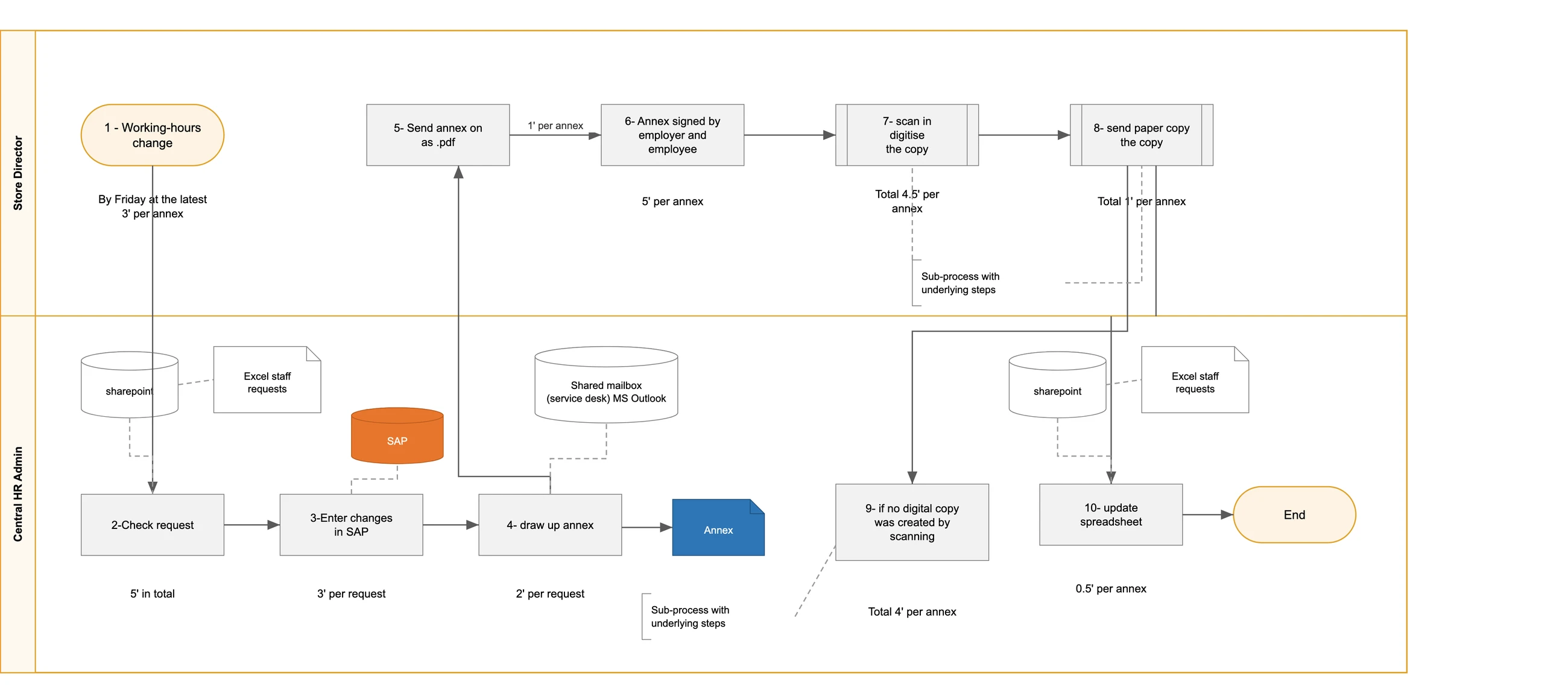
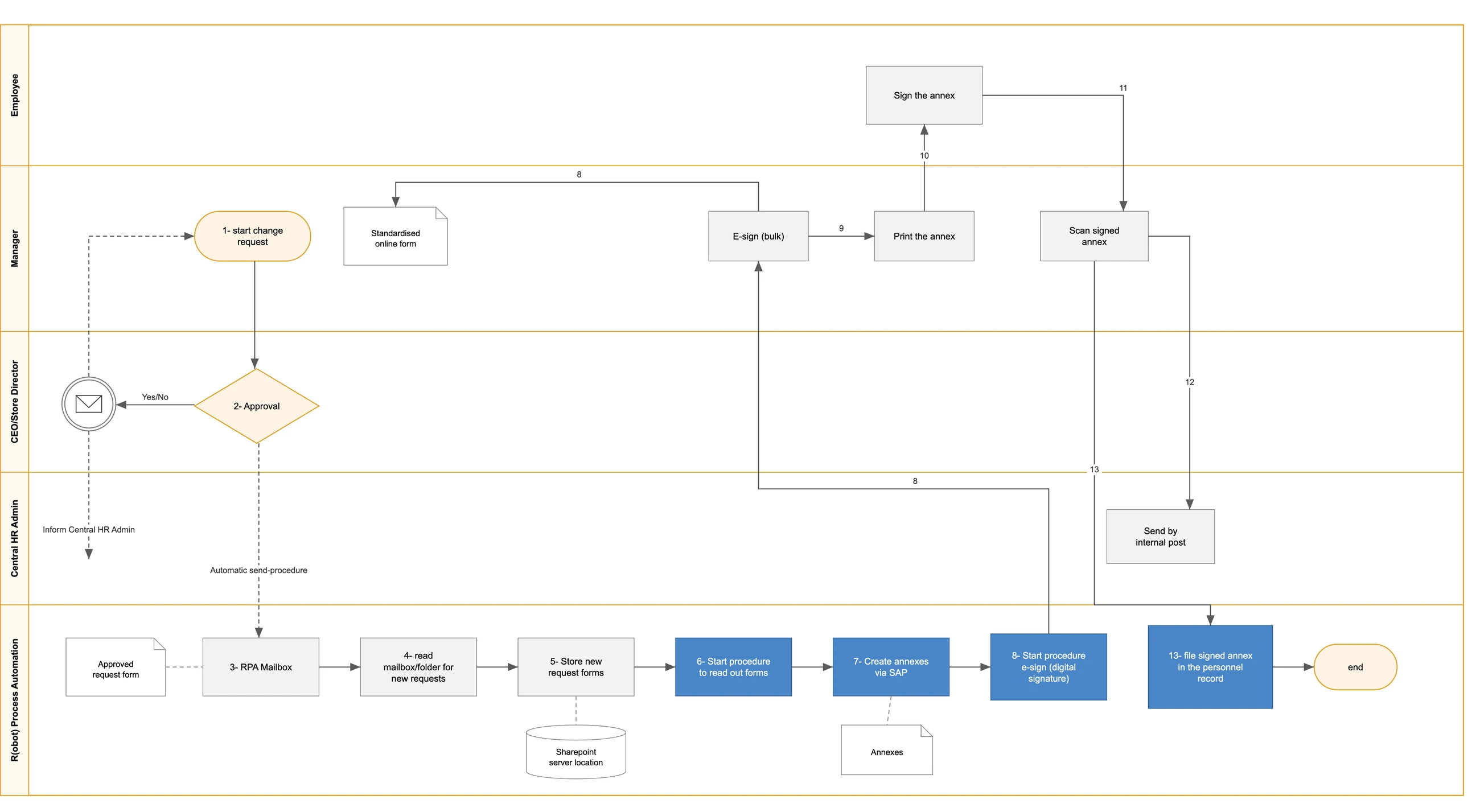
Ten steps, and where the case sits still
- 1start the request
- 2check the request
- 3enter the change
- 4draw up the annex
- 5send the annex on
- 6sign on paper
- 7scan it in
- 8send by internal post
- 9scan it in after all
- 10update the spreadsheet
29
2,013
3
3
What a review produces
Automation is the last step, not the first
Start with technology and you automate the process as it is - the most expensive way to change nothing. So every step passes four other questions first. Often half the work falls away before a single line of code is written.
What do you do with a step?
- 1Remove it
- 2Simplify or merge
- 3Move it: to the source, or in parallel
- 4Digitise, then automate with rules
- 5AI, for whatever is left
Where technology helps, and where it stays away
Whatever survives the first three rungs goes past two matrices. The first asks whether the work can be captured in rules: that is the territory of the software robot. The second asks whether there is a judgement in it that a person recognises but cannot write down: that is where language models are strong.
The two almost exclude each other. Which is exactly why a process that drops out for a robot is often interesting for a model - and the other way round. And there is a third outcome, as common as the other two: this stays human work.
First question
Suited to a software robot
- digital
- rule-based
- high transaction volume
- few exceptions
- little complexity in the process
- stable IT landscape
- low-complexity IT landscape
- consistent, structured input
- regular human error
Second question
Suited to a language model
- the work is text and language, not fields
- plenty of variation and exceptions
- there is material from past cases
- the rule cannot be written down, but a person recognises a right answer
- there is a moment where someone checks the outcome
- a mistake is cheap to correct
Where it does not belong, however well it scores
- the outcome affects someone personally and directly: hiring, appraisal, illness, dismissal
- mistakes are invisible, or only visible much later
- no one can judge the result any more
- personal data that must not leave the building
A robot that fails stops visibly. A model that fails keeps answering. That difference costs lasting human supervision, and it belongs in the return calculation.
What the score means
- 40 - 45
- 35 - 40
- 30 - 35
- below 30
How a review runs
On the wall, with the people who do the work. The process goes up on sticky notes, lane by lane, until everyone sees the same picture. That is usually the first moment the whole line is visible at once.
Writing it out and measuring. What is on the wall goes into the workbook. Only then come the numbers: lead time, share of actual work, handovers, consultations.
Redesigning with the ladder. Every step passes the five rungs, together with a working group from the organisation itself. What survives gets a business case.
Implementing and measuring again. A redesign that does not land changes nothing. Six months on we put the measured figures next to the calculated ones.
What it connects to
Waiting time appears wherever work passes from one pair of hands to another. How many pairs of hands there are follows from how the work is divided - and that is organisational design. A review starts at the process and nearly always arrives at that question.
- Process optimisation - the same process before and after, with the figures
- Contact - a conversation about your process commits you to nothing