About Factter.
For organisations that want change to land.
Factter is the organisational development practice of Kris Rayen. The name stands for Facilitate Teams towards Excellent Results. Factter redesigns how organisations work, structure and culture together, so change lands instead of piling up. Behind that approach sits one conviction: an organisation that buckles under its change load can no longer do what it exists to do.
Where this lens comes from
My first employer was a manufacturing company, strongly hierarchical. The thinking sat at the top, the doing on the floor. HR was administration: there was hardly any room to grow, not in your work and not in your pay. Everything was imposed. A system was rolled out that felt like control, and twenty years later the sales people still weren’t using it. Production, quality, logistics, marketing and accounting each worked from their own discipline, and you could feel the friction between them throughout the whole organisation.
I was young, and I thought: this has to change. In how we treat people, and in how we organise the work.
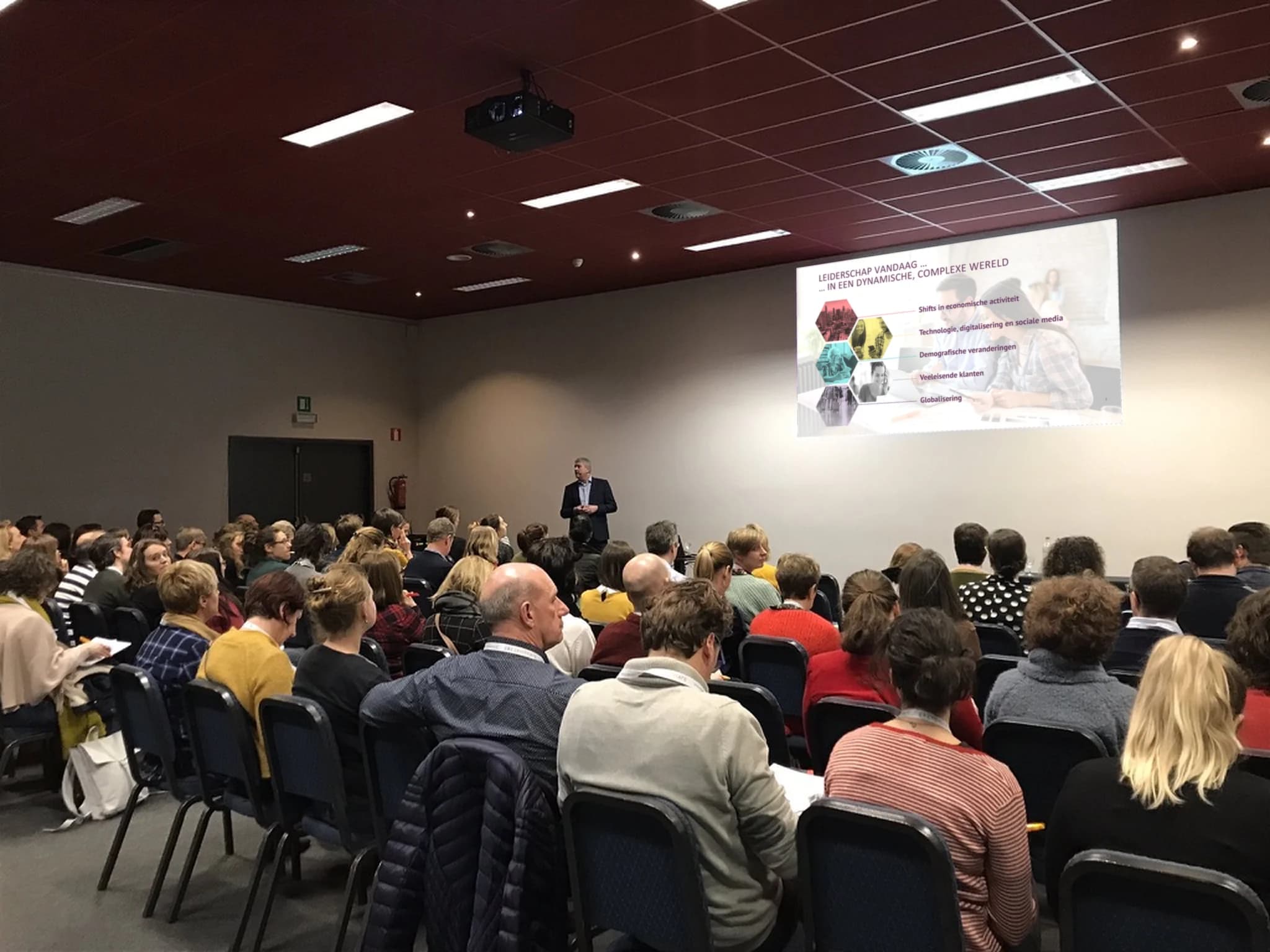
That thought became a career. I learned the HR trade in the staffing sector, where I ran my own agency with two hundred people working at client sites every day. I then went deep into people, change and behaviour, and discovered that processes steer that behaviour; so I trained in business processes and helped a printing company reinvent itself into a media house. I saw that technology steers the work too, and worked at the intersection of HR, IT and partner management. I saw leadership surface as a bottleneck in every organisation I got to know from the inside, and immersed myself in leadership, team development and well-being. And at the end of that road lay the question that had been underneath it all along: the structure itself. How the work is divided. The newest chapter wrote itself: AI. In a large public organisation I helped build AI governance from the inside, generative AI included: how do you make AI usable with quality and control, from policy and decision rights down to the workplace?
Everywhere I saw the same pattern return. Silos each selling their own service to the same client, until that client had five proposals from one house on the table and asked: could we have one point of contact? Colleagues competing with each other internally over the numbers, while the client could feel nothing was being aligned. Work so fragmented across departments that every decision had to pass everywhere first, nobody took final responsibility and postponement became the norm. And every time I thought the same thing: this is not about the people. They themselves feel that things could be different, often more sharply than anyone. It is about how the work is organised.
Everything is connected: I felt that already as a young employee. I then learned it theme by theme, through training and with my sleeves rolled up. HR, behaviour, processes, technology, leadership, teams, the structure that carries it all, and today AI as well. That whole, that is Factter.
People make organisations, organisations make people.
Why I do this
I have felt first-hand what work does to people, in every role I held and in every colleague next to me. My drive has not changed since: a better world of work, one that takes into account the human being behind the employee, and in which organisations can handle the future.
Change has become the only constant, and that is not a problem: that is normality. The task is a different one: lowering the change load where the design makes it needlessly high, and making bearable what remains. For the people and for the organisation. You don’t do that with an extra campaign or a tighter programme. You do it by designing the work differently.
Everything as one whole
Excellent specialists exist for every domain: work organisation, HR, leadership, team development, HR systems. What is rare is the combination: seeing and tackling everything as one whole. Structure that steers behaviour, processes that make culture, systems that determine how much room people get.
Holding that whole together is exactly what Factter does. One designer who holds the full working model, from the boardroom to the workplace, and who knows how each part acts on the others because he has done each part himself.
That whole is available today in two tracks: by carrying the leadership itself as interim general management, or by designing and delivering a transformation as one whole, until it works.
From tension to change that lasts. The approach in pictures.
Where this comes from
Factter began with three Dutch words: samen organiseren werkt - co-organising works.
Samen.
Together
Impose nothing, but build in co-creation with the people who do the work, because that is how ownership grows.
Organiseren.
Organising
Arranging the work differently and better.
Werkt.
Works
For the client, and for the people who make it happen every day.
That conviction has not changed. It has become sharper. Today it is also clear why co-organising works: because well-designed work can handle change.
Today it sounds like this
Organisations that can handle change.
Factter has existed since 2019, as the independent practice of Kris Rayen. But what is inside is older: the craft of a full career, built in the private sector and the public sector, in small and medium-sized organisations and in international companies. You will find a selection of projects in the cases; the organisations behind that work are on the home page.
- Founded in 2019
- Lier, Belgium
- Private and public sector
Do you recognise your own organisation somewhere in this story? Then a conversation about how work is organised where you are, and how it could be different, is the next step.