Organisation design
Structure determines how much change load you carry. Redesigning around work streams instead of functions turns change into something teams absorb locally, instead of a project that has to travel through the whole house.

Carrying the responsibility, or helping to carry it.
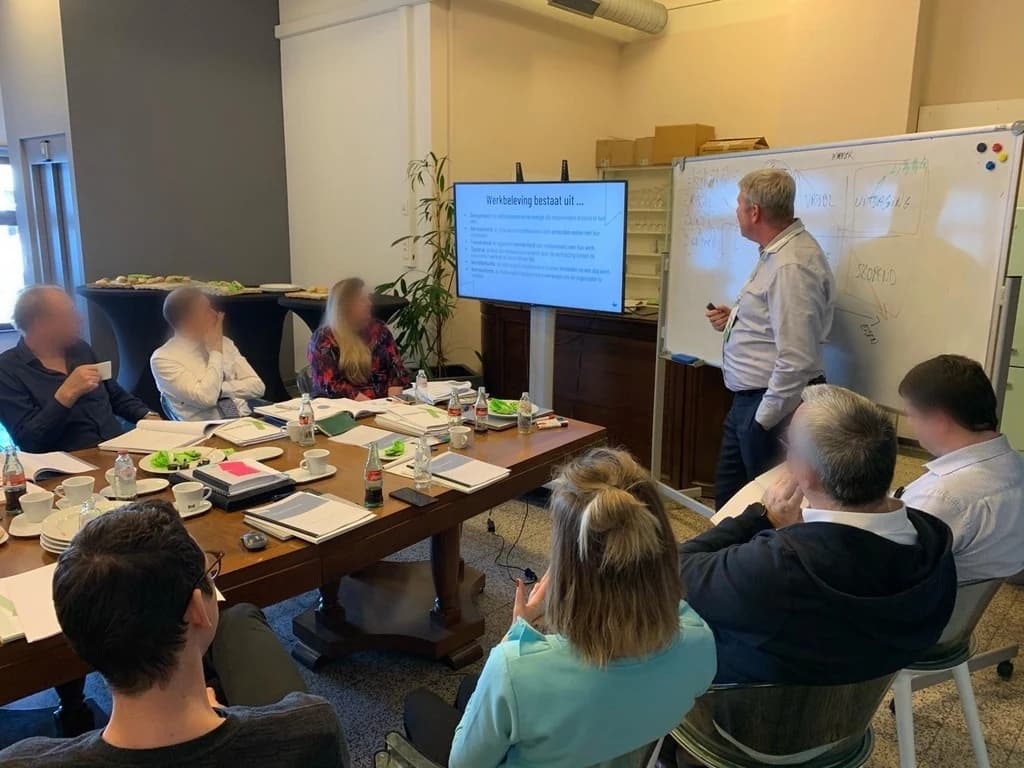
Factter helps organisations structurally lower their change load. The offer is ordered by involvement, in two forms: carrying the responsibility through interim general management, or designing and implementing as one whole. The front door is the same for both: the Change Map.
The owner wants to step back from day-to-day work, but the organisation still hangs on his calendar.
An acquisition or merger calls for one way of working, and for now there are two.
The next generation is taking over and wants to do things differently, but everything still runs along the old routes.
The company has grown faster than its structure; what used to happen by itself now takes a meeting.
The market is shifting, while the organisation grew along with the past.
AI is on every board agenda, but lands nowhere in the work.
Six different triggers, one shared feature: the organisation has to make a step change that goes beyond its normal rhythm. The question is then not whether something has to happen, but who carries it and how it keeps working.
The moments do the defining, not the size or the sector. Anyone who recognises themselves in one of the six recognises themselves rightly: whether that is a family business, a business unit, a non-profit or a public entity.
For whom
The moments above say when organisations call. Which shape that load takes depends on who you answer to. Three situations keep coming back.
The organisation stands on its own
“Something is always running, and nobody watches what it all does to the people together.”
The organisation belongs to a group
“I explain more to head office than I work on my own market.”
The owner is an investor
“Every acquisition or change of ownership piles on the previous one, and the pressure to show value stays.”
Not a catalogue of services, but a choice of involvement: how much responsibility does Factter carry.
Both forms carry the same work: leading the transformation and giving it direction, supported by expertise built up domain by domain. What differs is the seat from which that happens.
The front door is always the same: the Change Map makes visible where the load comes from. If the choice is still open, it gives you the ground to decide on. If you have already made your choice, it sharpens and confirms the picture you start with.
Interim general management for an organisation that has to make a step change.
Interim in the line, with a mandate over people, resources and decisions. The promise is twofold. In the short term the shop keeps running: decisions get made, people know where they stand. In the longer term the organisation has been redrawn and the new design implemented: a more effective and more efficient operation, in which the next change costs less.
Classic interim management brings experience in the line: managing, deciding, reporting. The difference is what comes with it here: depth across every domain an SME runs on, and a design approach to make the step change hold structurally.
An SME has support functions such as HR, finance and IT, sometimes with teams behind them, but rarely a full management layer in which every domain has its own accountable director. In a step change especially, those domains come together in one seat: the director has to be able to judge and adjust them personally, not refer them to a specialist who takes over. That is exactly what this profile is built for: every domain an SME gets stuck on, known from the inside.
Not a collection of interests, but a build-up: every layer explains why the next was needed. See the evidence per domain →
A mandate means executive capacity for the duration of the step change, without the cost and the commitment of a permanent hire. Full-time where the job calls for it, or as a part-time mandate, two to three days a week, over a longer period.
Diagnosis, design of structure, operation and collaboration, and then leading the trajectory through to delivery. With accountability for the outcome and management of a multidisciplinary team. Whoever designs without implementing delivers a plan. Whoever implements without designing moves the problem around. That is why both are delivered as one whole.
The work streams come first, not the org chart: which streams create value, how is the work divided between people and AI, where is human judgment indispensable, and which roles and teams belong to that. Decision space moves close to the work; coordination becomes light instead of heavy. Every track starts from Factter’s coherent working model: structure and culture together, the visible side and the undercurrent.
The outcome is not a report that disappears into a drawer, but an organisation that works client-first and absorbs the next change on its own. The same route applies to larger organisations and public entities that want a transformation led for them.
The front door
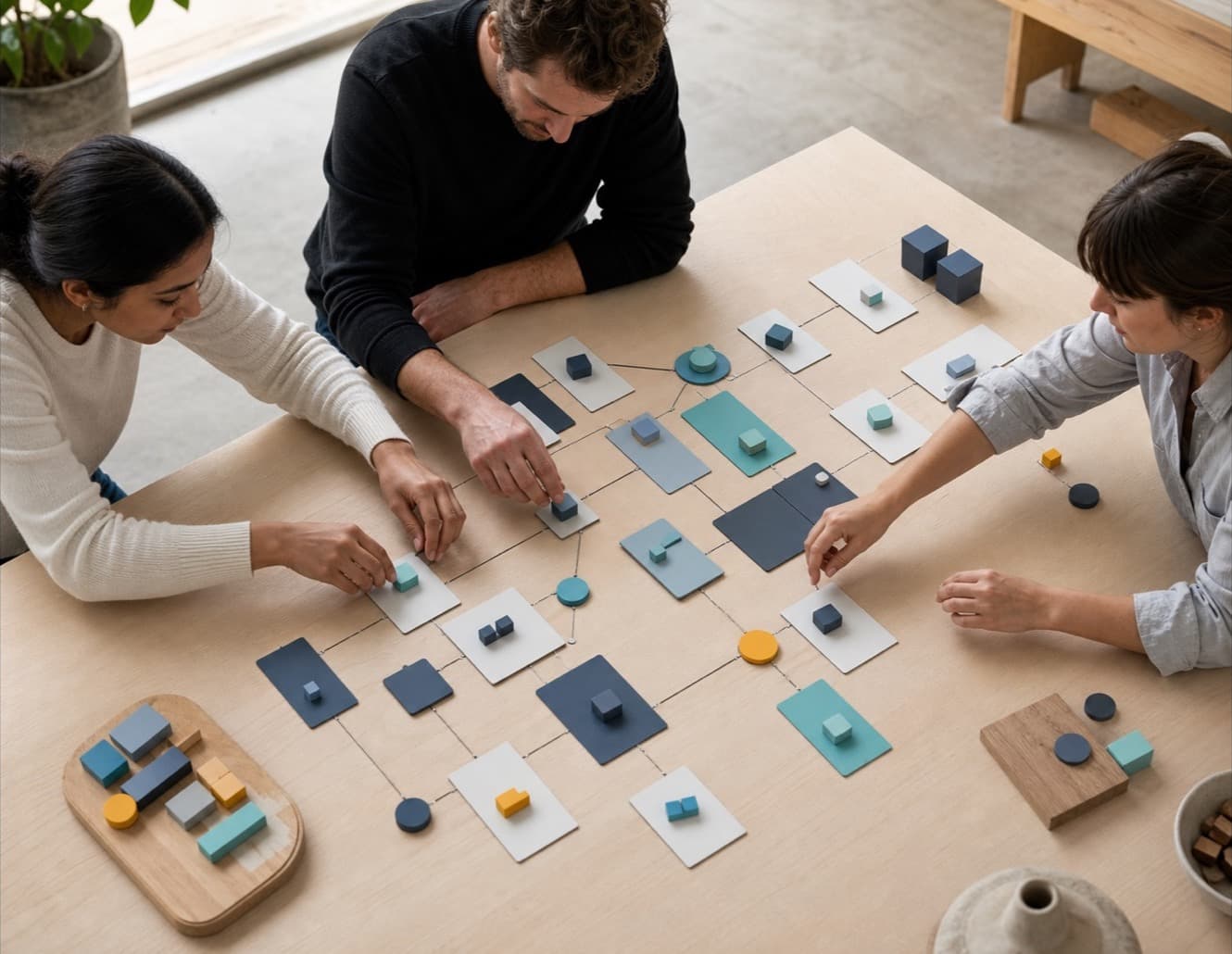
Whichever form you choose, every engagement starts here. The diagnosis makes visible where the load comes from: ground to decide on when the choice is still open, sharpening and confirmation when it has already been made.
The Change Map is a compact, clearly scoped investigation that makes visible where change piles up in your organisation and which structural features cause it. You receive a compact board-level advisory with an ordered ranking of bottlenecks and a design direction. No scores or dashboards, but an expert judgment a board can decide on.
You don’t get a figure that lets you compare yourself with other organisations. That figure doesn’t exist: there is no validated measure that makes change load comparable between organisations, so a benchmark would only pretend. What can be done is counting within your own house: between changes, between departments, before and after a redesign. That is comparable where it matters.
How earlier changes ended helps determine how the next one is received. Not the number of them, but whether commitments were kept. Anyone who ignores that reads reticence as unwillingness, while it is often a reasonable judgment based on what people have been through. That is why the past belongs in the picture, alongside what is running today.
The diagnosis looks at five things: what is changing and who it touches, how the previous rounds ended, the road change travels through the organisation, where it stalls, and how much room is left. The five building blocks, each with its question.
Structured survey
Targeted interviews
Advisory and feedback
Design variable
The starting point is the work; AI and technology come in from there: which tasks does AI strengthen, where does human judgment make the difference, and which organisation keeps that collaboration agile? Where that practice comes from and how it works methodically is on the approach page.
That is why AI runs as a design variable through the entire offer. In the Change Map an AI module sharpens the picture when AI is the trigger. In a track the work is divided between people and AI and the organisation that keeps that agile is designed. In a mandate AI is one of the domains a director has to be able to judge personally today.
AI transformation that stalls is usually a structural problem: the organisation carries too much change load. And that can be designed.
This is the layer where you intervene. The diagnosis maps where the load sits, then you choose what stops, waits or has to change, and only then does something change in the work itself. That happens in five places. See the whole chain.
So not separate services, but the expertise the two forms above rest on. A mandate is broader than these five: commercial, procurement and systems belong to it too. The common thread is always workable work, jobs with room to adjust and demands that remain bearable, even when AI changes the work.
Structure determines how much change load you carry. Redesigning around work streams instead of functions turns change into something teams absorb locally, instead of a project that has to travel through the whole house.
Where structure lets change pile up, managers become pass-through and bottleneck at once. Shared leadership that fits the design leaves decisions where the work is. That is what brings a new design to life.
Two sides of the same team. The design determines whether a team can work: a recognisable assignment and the room to adjust on its own. The relations determine whether it actually does. First the design, then the interplay.
HR processes and HR systems can support room to adjust, or chase every adjustment through a chain of approvals. Factter guides HR transformation from process redesign to the selection, implementation and adoption of an HRIS. Not an IT project but an organisational question: first the work, then the system.
Optimising processes inside the wrong structure moves the problem around: every improvement stalls at the next departmental boundary. Flows first, then the steps within them. That way an improvement still stands when the next change comes.

The Change Map is a compact, clearly scoped investigation that makes visible where change piles up in an organisation and which structural features cause it. The outcome is a compact board-level advisory with an ordered ranking of bottlenecks and a design direction: no scores, but a judgment you can decide on.
Yes. Factter takes mandates as interim general management at organisations that have to make a step change, full-time or as a part-time mandate of two to three days a week over a longer period. The difference with classic interim management: alongside the day-to-day leadership, the organisation is redrawn so that the next change costs less.
On request, yes, but it is not what Factter stands for. A design nobody carries raises the change load instead of lowering it. That is why design and implementation are delivered as one whole, and why line responsibility is carried where needed.
The advisory stands on its own; it also describes what your organisation can pick up itself. If you want to continue, there are two forms: designing and implementing as one whole, or an interim mandate in which Factter carries the responsibility. The diagnosis commits you to nothing.
That depends on the size of your organisation, the calendars and the pace you want to keep. The diagnosis is deliberately compact and clearly scoped; a redesign track follows the rhythm of your teams. A first conversation makes that concrete.
Because a broad, structured survey yields a more complete and more honest pattern than an interview round alone, and asks far less of calendars. The interviews come after, targeted: only where the pattern raises questions.
Yes. Factter guides the selection and implementation of HR systems (HRIS) as an organisational question: first the work and the HR processes, then the system. That order determines whether an HRIS implementation gets used or just rolled out.
Factter is an organisation designer, with AI as a full design variable in every diagnosis and every track. The starting point is the work; AI and technology come in from there: how do you divide the work between people and AI, and which structure keeps that agile? Factter helped build AI governance from the inside in large organisations.
With both, in coherence: that is the core of the working model. Structure determines where change piles up; leadership, teams and HR processes make it land. So the design of the work comes first, and leadership, collaboration and culture move along from there. Culture does not change on command, but it does change by organising differently.
The Change Map has a fixed price. Tracks and interim mandates are agreed case by case, usually after a diagnosis, so the scope rests on facts instead of estimates.
Wherever you start: every step leaves behind something that works, even if you stop after it.