First make it visible, then change it.
Change doesn't start with a plan, but with seeing what's really happening. Where does the work get stuck, what does a team carry and what not, how do leaders see their role, and what does the structure say about that?
This is Factter's toolbox: instruments that make that visible, from the individual to the whole organisation. They never stand on their own. What they surface becomes material for the conversation and for the design that follows.
The toolbox
The instruments
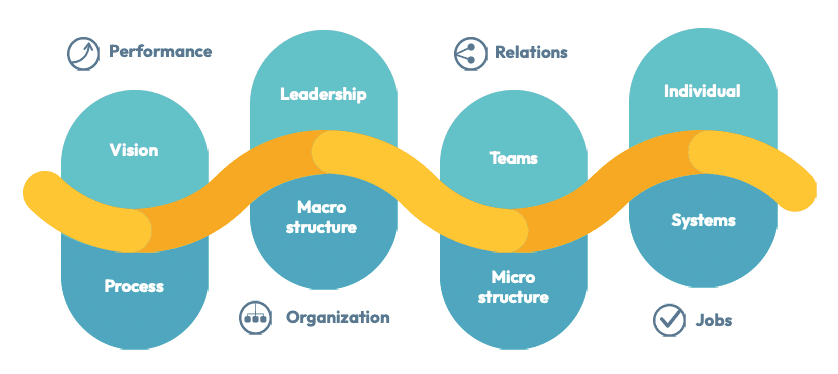
In tracks, Factter works with a set of instruments that grows with the question, ordered by level: from the individual to the whole organisation. Every instrument starts from the same principle: first make it visible, then change it.
Next step: the Change Map
And then?
An instrument yields a picture, not an answer. The question after is always the same: where is change piling up, and which design causes it? That is what the Change Map does: a broad survey across your organisation, targeted deepening where the picture raises questions, and a board-level advisory you can decide on.
But that doesn't have to be today. Read more about the diagnosis first, or simply get in touch: the conversation is always the first step, and it commits you to nothing.
Divided by function
Every change runs through the whole house
8places have to move along
Around flows
The same change lands in one place
1place moves along, the rest keeps working
Frequently asked questions
When a picture is missing that's needed to design or decide. Never as a starting point on its own: the question first, then the instrument that fits it. Sometimes no instrument is needed at all and a series of conversations suffices.
What you get is an ordered picture and a conversation about it, not a number. Change load and workability don't lend themselves to a score, and a score would give false precision that makes nothing decidable. Procesdoorlichting does work with scores, but they are about processes and not about people: about properties you can simply check. There too the outcome is not a verdict but an order of play - which process first.
You can, but it's rarely the best route. A picture without follow-up changes nothing, and the value sits in what happens next: the design and the implementation. Usually a conversation about your question is the better first step.
It stays within the engagement and is only used for what it was collected for. Feedback happens at board, department and team level, and always anonymised: the picture is about the group, never about the individual.
It doesn't pinch because your people don't want to. It pinches because the work is organised the way it is. Seeing that is the first step; changing it is our craft.